
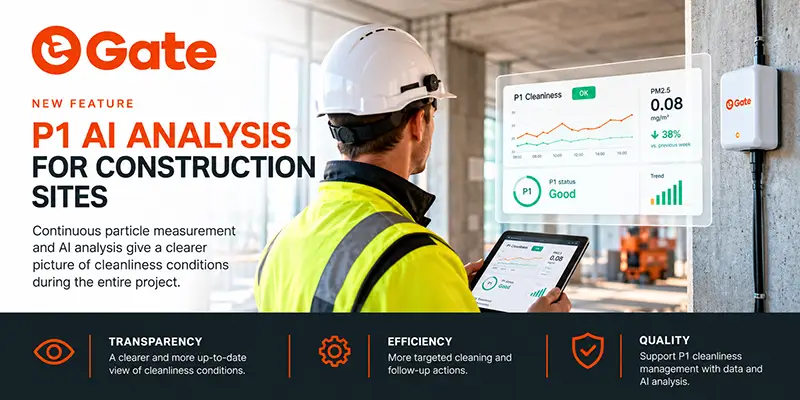
One of eGate’s original goals, more than a decade ago, was to develop a tool for P1 cleanliness management professionals that provides up-to-date information on site conditions and supports the management of cleanliness processes both on site and remotely.
Traditionally, verification of P1 cleanliness relies on site inspections and surface-dust measurements, which document cleanliness at specific points in time. Continuous particle measurement and eGate AI Insights analysis complement these methods by also revealing how dust conditions change between inspections.
Earlier studies have found relationships between eGate measurement data and results from other dust measurement methods. A study published in 2024 compared eGate measurements with results obtained using a cyclone sampler for occupational hygiene dust sampling. A study published in 2026 found a strong correlation between airborne particle concentrations measured by eGate and surface-dust measurement results.
The new P1 cleanliness analysis in eGate AI Insights brings continuous particle measurement and AI-powered analysis to professionals responsible for P1 cleanliness management. It helps provide a more up-to-date picture of site conditions, track changes in particle concentrations and identify situations that may require further investigation or action.
Companies responsible for P1 cleaning can use the data to manage the quality of their own work, assess results and target follow-up actions. The client’s P1 cleanliness consultant gains measurement-based information to guide and assess quality, supporting more efficient and transparent cleanliness management. Site management gains a more current view of P1 cleanliness conditions and how they are changing.
All parties can use the same situation overview both on site and remotely. This supports information sharing, collaboration and timely decision-making.
An up-to-date picture of conditions helps teams schedule inspections at the right time and direct actions where they are needed. When the status of P1 cleanliness management is clearer and potential deviations can be addressed early, work can progress more efficiently. This can help reduce delays during construction as well as schedule and cost pressures near project completion, supporting smoother progress toward handover.
The P1 cleanliness analysis complements traditional methods. It does not replace surface-dust sampling, assessments under the INSTA 800 standard or other cleanliness verification methods required for a project. Continuous particle measurement also does not replace occupational hygiene measurements needed to assess workers’ exposure.
Explore the research:
P1 cleanliness management: www.e-gate.io/2026/05/15/study-real-time-particle-monitoring-in-p1-construction-egate/
Construction-site dust measurement and occupational hygiene comparison: www.e-gate.io/2024/04/23/breakthrough-in-construction-safety-egate-validated-for-real-time-dust-monitoring/
eGate AI Insights is an AI-powered analytics solution that uses eGate IoT measurement data to support continuous improvement in construction across three distinct areas:
- Occupational safety: analysing airborne particle concentrations and helping identify situations involving potential dust-exposure risks.
- P1 cleanliness management: analysing site dust conditions, supporting quality management by cleaning providers, and giving the client’s P1 consultant and site management an up-to-date situation overview.
- Concrete drying and strength: calculating drying progress and strength development to support decision-making.
eGate is a continuous-improvement platform for EHSQ professionals in construction. eGate AI Insights helps turn measurement data into analysis that supports decision-making and the improvement of site quality, safety and compliance.
MEASURE – ANALYZE – DECIDE – IMPROVE
#eGate #eGateAIInsights #IoT #AI #P1 #CleanlinessManagement #OccupationalSafety #Concrete #EHSQ #Construction
What does P1 cleanliness management mean?
P1 is a construction cleanliness class defined in Finland’s Indoor Climate Classification. Its aim is to ensure that spaces are clean before handover and to prevent construction dust and other contaminants from spreading into completed spaces and ventilation systems.
P1 cleanliness management is used, for example, in office buildings, schools, daycare centres, residential buildings, healthcare facilities and other public buildings, as well as commercial and business premises. P1 requirements may apply to new construction or renovation, and to an entire project or only specified spaces and work phases. The scope is defined by the project documents and cleanliness requirements.